 English
 Español
Zhongsheng
Zhongsheng
Zhongsheng
Zhongsheng
Zhongsheng
Zhongsheng
Zhongsheng
Zhongsheng
Zhongsheng
Zhongsheng
Zhongsheng
Zhongsheng
Zhongsheng
Zhongsheng
Zhongsheng
Surface irregularity in veneered wardrobes often becomes noticeable only after installation and exposure to indoor environments. The effect is not random; it reflects internal wood movement, adhesive behavior, and substrate interaction. Products such as wood veneer for wardrobe panels rely on a thin decorative layer bonded to engineered boards, which respond differently to environmental changes. This structural mismatch can reveal grain distortion that was not visible during manufacturing.
Understanding this phenomenon requires attention to moisture behavior, material layering, and production tolerances rather than surface appearance alone.
Material Layer Interaction Behind Visible Grain Changes
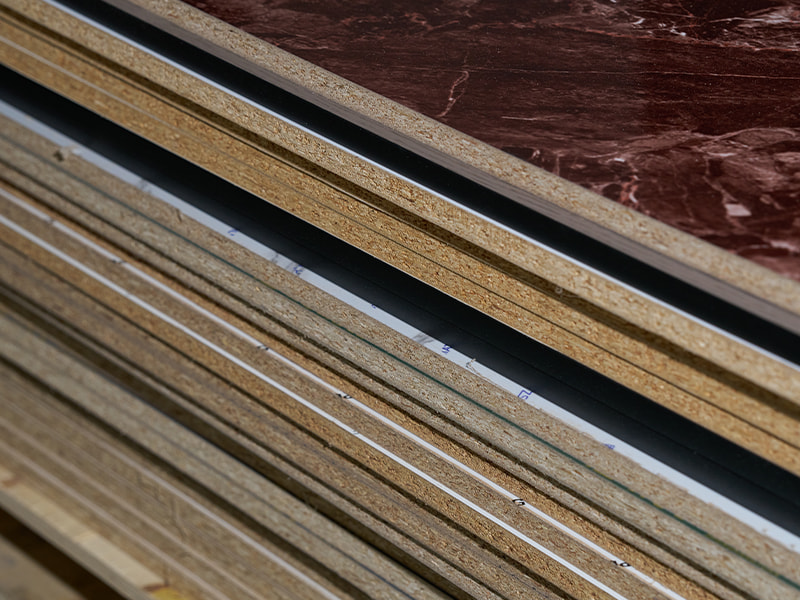
Structural composition of veneered wardrobe panels
Most wardrobe panels use a layered structure:
- Face veneer (0.3–1.0 mm natural wood layer)
- Adhesive resin layer (urea-formaldehyde or PVAc-based systems)
- Core board (MDF, particleboard, or plywood)
Each layer reacts differently to humidity and temperature variation. The veneer expands and contracts along grain lines, while MDF or particleboard responds more uniformly. This imbalance creates stress along the adhesive interface.
Why grain distortion becomes visible later
Grain patterns may appear stable at the factory stage, but after installation:
- Indoor humidity cycles trigger micro-expansion of wood fibers
- Core board remains relatively dimensionally stable
- Adhesive tension redistributes across the panel surface
These interactions cause slight lifting or compression along the grain direction, which visually translates into uneven grain alignment or “shadowing” effects.
Moisture Differential as a Primary Structural Trigger
Humidity imbalance between layers
Wood veneer reacts strongly to relative humidity changes. Studies in wood engineering show that veneer checking and distortion commonly originate from moisture content differences between face veneer and substrate materials.
Indoor wardrobes are especially exposed because enclosed spaces trap microclimates. A wardrobe placed near exterior walls or HVAC vents may experience alternating dry and humid zones.
Typical moisture response behavior
| Component | Response to humidity | Visible effect |
| Wood veneer surface | Fast expansion/contraction along grain | Wavy grain lines or uneven reflection |
| MDF/particleboard core | Slow, uniform swelling | Minimal visible change |
| Adhesive layer | Viscoelastic deformation under stress | Localized surface tension marks |
The mismatch between these behaviors produces subtle surface deformation that becomes visible under angled lighting.
Grain Distortion Patterns and Their Technical Origins
Parallel-line checking effect
Distorted grain often follows wood fiber direction. This is linked to internal stress fractures developing along cellulose structure. Such checks typically run parallel with grain orientation rather than random cracking patterns.
Non-uniform veneer cutting influence
Some distortion originates before installation:
- Irregular log growth zones create variable fiber density
- Tension wood areas shrink differently during drying
- Rotary-cut veneer introduces alternating grain visibility
These pre-existing conditions amplify optical distortion once installed on large wardrobe surfaces.
Installation Conditions Affecting Grain Stability
Substrate stress during assembly
Panel mounting introduces mechanical constraints. Screws, edge banding, and frame pressure restrict natural movement. As a result, stress accumulates within veneer layers rather than distributing evenly.
Common installation-related contributors
- Over-tightened fixing points restricting panel expansion
- Uneven wall contact causing panel torsion
- Insufficient acclimatization before mounting
Even minor deviation in flatness can exaggerate grain visual distortion under directional lighting.
Technical Parameter Comparison Table
| Parameter | Natural veneer layer | MDF substrate |
| Thickness range | 0.3–1.0 mm | 15–25 mm |
| Moisture expansion rate | High (anisotropic) | Low (isotropic) |
| Elastic response | Fiber-direction sensitive | Uniform response |
| Surface stability | Moderate under climate shifts | Stable under normal indoor conditions |
Differences above explain why the surface layer visually shifts even though the structural board remains unchanged.
Lighting and Optical Amplification Effects
Directional reflection behavior
Grain distortion becomes more noticeable under:
- Side lighting from windows
- LED strip lighting installed inside wardrobes
- Gloss or semi-matte finishes
Wood fibers reflect light differently depending on their compression angle. Slight deformation changes reflection paths, making grain appear uneven even when physical displacement is minimal.
Material Processing and Manufacturing Influence
Adhesive spread and press uniformity
Inconsistent glue application or uneven pressing pressure can create micro-voids under veneer layers. Over time, these zones respond differently to environmental stress, forming visible grain distortion zones.
Thickness variation sensitivity
Even small variations in veneer thickness (±0.1 mm) can influence stress distribution across large wardrobe panels. Thinner zones flex more easily, amplifying surface irregularities.
Conclusion
Visible grain distortion in veneered wardrobes is not a surface defect alone but a layered structural response. The interaction between wood fiber movement, substrate stability, and environmental humidity produces subtle deformation patterns that emerge after installation. Rather than being a manufacturing flaw in isolation, it reflects the natural behavior of composite wood systems under real indoor conditions.
Understanding these mechanisms helps interpret why decorative surfaces like wood veneer for wardrobe can shift visually over time while maintaining overall structural integrity.