MDF-Based Boards and Panels: Custom MDF Panels, Faced MDF Board, Fiberboard Furniture & MDF Board Explained
Medium Density Fiberboard (MDF) is one of the most widely used engineered wood materials in modern furniture manufacturing and interior decoration. Because it is stable, easy to machine, and highly adaptable to surface finishing, it appears in many product search variations such as Custom MDF Panels, Faced MDF Board, Board of MDF, Fiberboard Furniture, and MDF Board.
Although these terms are often used interchangeably in buyer searches, they actually reflect different levels of processing, finishing, and application intent within the MDF ecosystem.
What Is MDF Board?
MDF Board is an engineered wood product made by breaking down hardwood or softwood residuals into wood fibers, combining them with resin and wax, and then compressing them under high temperature and pressure into dense panels.
Key characteristics:
- Smooth and uniform surface (no knots or grain variation)
- Easy to cut, route, and shape with CNC machining
- Stable dimensional performance compared to natural wood
- Suitable for surface lamination, painting, and PVC/PET/PETG finishing
Common applications:
Furniture manufacturing (cabinets, wardrobes, desks)
- Interior wall panels
- Door core materials
- Decorative base boards
From a search intent perspective, “MDF Board” is the most general keyword and usually represents early-stage material research or price comparison queries.
What Are Custom MDF Panels?
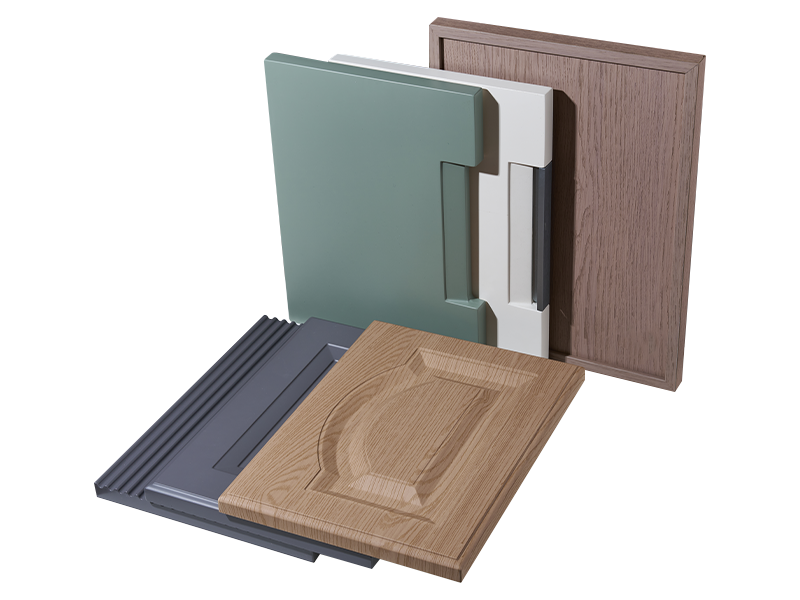
Custom MDF Panels refer to MDF boards that are manufactured or processed according to specific project requirements such as size, thickness, shape, edge profile, or surface design.
Unlike standard MDF sheets, custom panels are tailored for design-driven or industrial applications.
Typical customization options:
- CNC-cut shapes and patterns
- Pre-laminated decorative surfaces (PVC, melamine, PET, etc.)
- Pre-drilled holes for assembly systems
- Special edge profiles (rounded, beveled, grooved)
Application scenarios:
- Modular furniture systems
- Architectural wall cladding panels
- Retail display structures
- High-end customized cabinetry
Search intent for “Custom MDF Panels” is usually linked to OEM furniture production or project-based interior design requirements rather than raw material sourcing.
What Is Faced MDF Board?
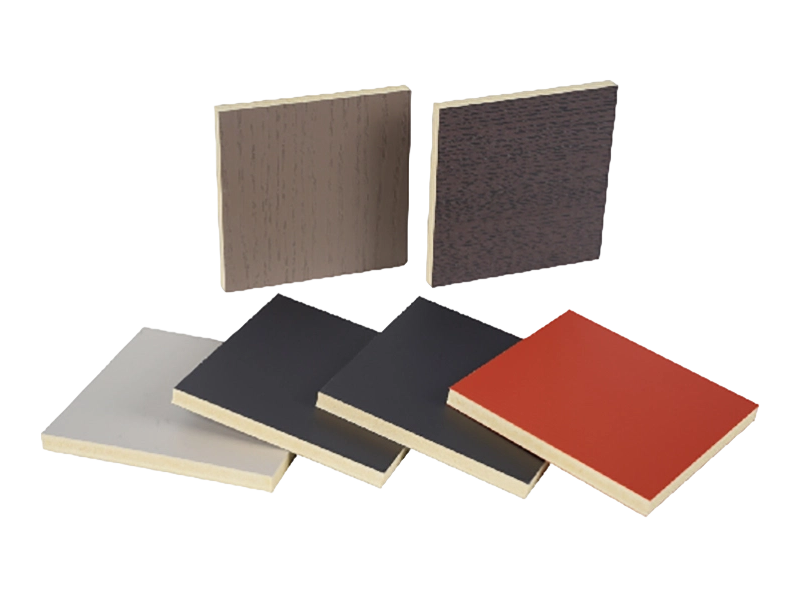
Faced MDF Board is MDF that has been covered with a decorative or protective surface layer, such as:
- Melamine paper
- PVC film
- Wood veneer
- PET or PETG decorative film
The “facing” process transforms raw MDF into a ready-to-use surface material.
Core advantages:
- Improved scratch and moisture resistance
- Ready-to-install decorative finish
- Reduced need for post-processing (painting or coating)
- Consistent visual appearance in mass production
Common uses:
- Kitchen cabinets and wardrobes
- Office furniture systems
- Retail shelving units
- Interior wall paneling systems
In real procurement behavior, users searching for “Faced MDF Board” are often comparing factory-finished boards rather than raw MDF material.
What Is Fiberboard Furniture?
Fiberboard Furniture refers to furniture products manufactured primarily using MDF or other fiberboard materials as the core structural component.
This category is not a material itself, but rather a product application term used in furniture manufacturing and retail.
Key characteristics:
- Cost-efficient alternative to solid wood furniture
- Highly customizable in shape and finish
- Compatible with flat-pack (RTA) furniture systems
- Suitable for mass production and export markets
Common examples:
- Flat-pack wardrobes
- Modular kitchen cabinets
- Office desks and storage units
- Retail display furniture
How These MDF Terms Are Connected
Although these keywords appear separately in search behavior, they represent a structured material-to-product hierarchy:
- MDF Board → raw engineered fiberboard material
- Faced MDF Board → MDF with decorative or protective surface finishing
- Custom MDF Panels → MDF processed into project-specific dimensions or designs
- Fiberboard Furniture → finished furniture products made using MDF as the core material
This progression reflects the full value chain from raw material to finished interior product.
Key Differences in Real-World Usage
1. Material stage
MDF Board → raw substrate
Faced MDF Board → semi-finished decorative panel
Custom MDF Panels → processed, design-ready component
Fiberboard Furniture → final consumer product
2. Level of customization
MDF Board → low
Faced MDF Board → medium (surface-based)
Custom MDF Panels → high (structural + decorative)
Fiberboard Furniture → product-level customization
3. Market intent
MDF Board → material procurement
Faced MDF Board → furniture manufacturing input
Custom MDF Panels → OEM and project-based sourcing
Fiberboard Furniture → retail or wholesale furniture buyers
Application Scenarios in Modern Industry
Furniture manufacturing
MDF is widely used for cabinet doors, shelving systems, and modular furniture due to its machinability and smooth finish.
Interior design projects
Faced MDF panels are commonly used for wall systems, decorative surfaces, and architectural installations.
OEM and customization markets
Custom MDF panels enable flexible production for branded furniture lines and project-specific designs.
Consumer furniture markets
Fiberboard furniture dominates flat-pack and export-oriented furniture categories due to its cost efficiency and scalability.
Choosing the Right MDF Solution
Selection depends on how far along the value chain the buyer is.
If the requirement is raw material sourcing, standard MDF Board is the base option.
If the focus is ready-to-use decorative surfaces, Faced MDF Board provides better efficiency.
If the project requires customized shapes, sizes, or CNC processing, Custom MDF Panels are more appropriate.
If the goal is finished furniture production or retail purchase, Fiberboard Furniture becomes the end-use category.
Final Perspective
The MDF ecosystem is not defined by a single product but by a layered system that connects raw material, processed panels, and finished furniture. Terms like MDF Board, Faced MDF Board, Custom MDF Panels, and Fiberboard Furniture represent different stages of this value chain.
Understanding these distinctions helps buyers, manufacturers, and designers align material selection with production efficiency, design intent, and cost structure—especially in global furniture and interior supply markets.
 English
 Español