 English
 Español

Zhongsheng
Zhongsheng
Zhongsheng
Zhongsheng
Zhongsheng
Zhongsheng
Zhongsheng
Zhongsheng
Zhongsheng
Zhongsheng
Zhongsheng
Zhongsheng
Zhongsheng
Zhongsheng
Zhongsheng
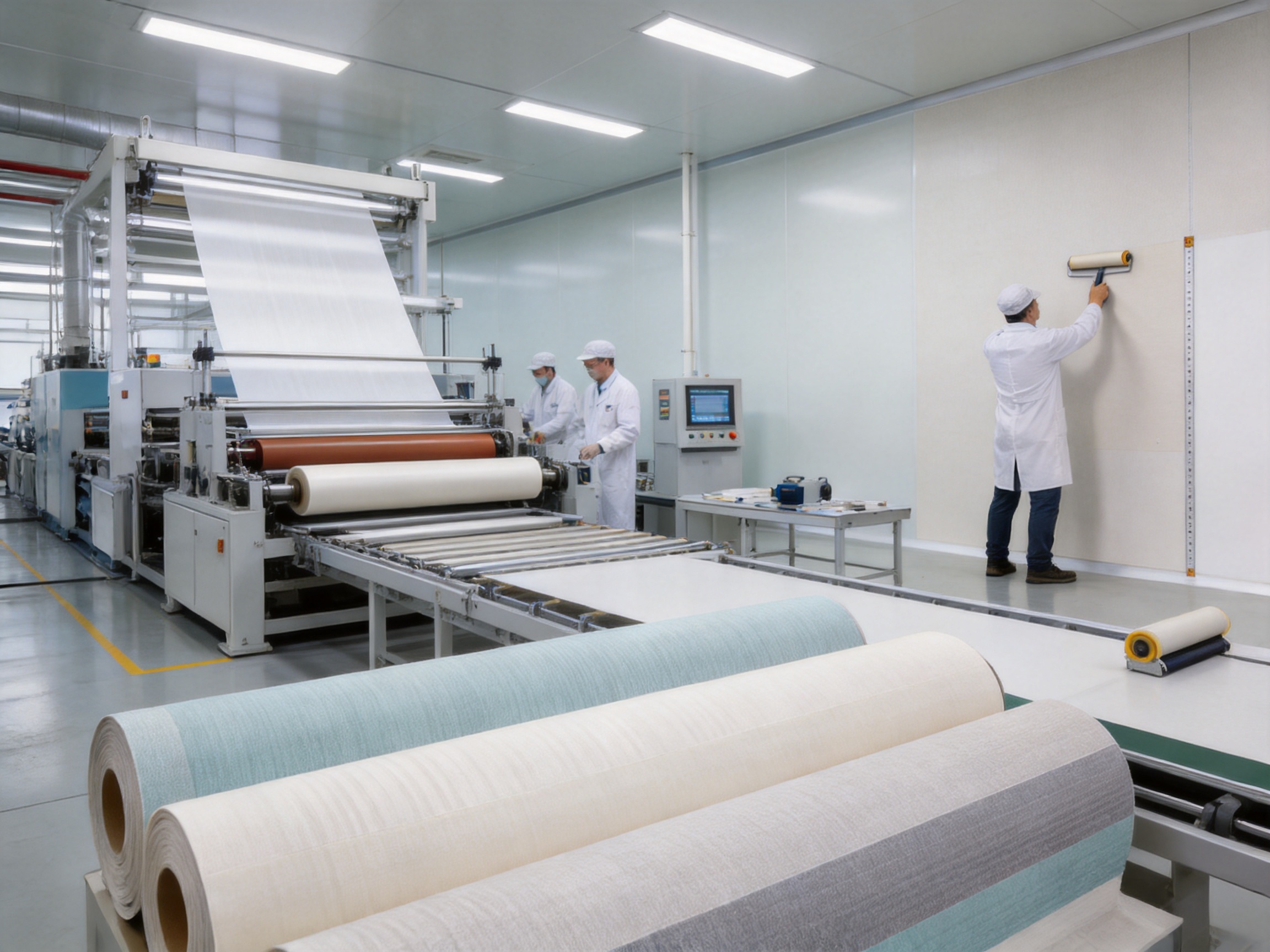
Interior decoration increasingly requires materials that combine visual appeal, practical durability, easy maintenance, and efficient installation. Square Pattern PVC Wallpaper responds to these demands with a contemporary surface design, resilient PVC construction, and a selection of textures suitable for residential, hospitality, and commercial environments. Its square grid, linen-inspired, and striped patterns provide designers with a flexible decorative surface that can support both minimalist and more expressive interior concepts.
Unlike ordinary paper wallpaper, which may be more vulnerable to moisture, staining, and surface wear, this PVC wallpaper is designed for demanding interior applications. It offers a soft tactile feel while maintaining a stable, easy-to-clean surface. The embossed finish adds visual depth without making the wall appear excessively busy, helping create interiors that feel refined, orderly, and comfortable.
This article examines the product’s design characteristics, material advantages, manufacturing considerations, installation value, application possibilities, and the production strengths of ZheJiang ZhongSheng New Materials Co., Ltd. It also explains how the product can provide a practical alternative to conventional wallpaper, paint, laminate, and other decorative wall finishes.
1. Product Overview
Square Pattern PVC Wallpaper is a decorative wall covering made with a PVC surface featuring square pattern printing and embossing. The design family includes square grids, linen textures, and striped visual effects. These patterns are intended to deliver a modern architectural appearance while retaining the warmth and tactile impression often associated with textile-inspired materials.
The wallpaper is suitable for direct wrapping or application onto prepared wall surfaces. Its regular width is 1370 millimeters, while customized dimensions may be available according to project requirements. Colors can be selected from existing patterns or developed according to a customer’s preferred design direction, allowing the product to support coordinated interior schemes.
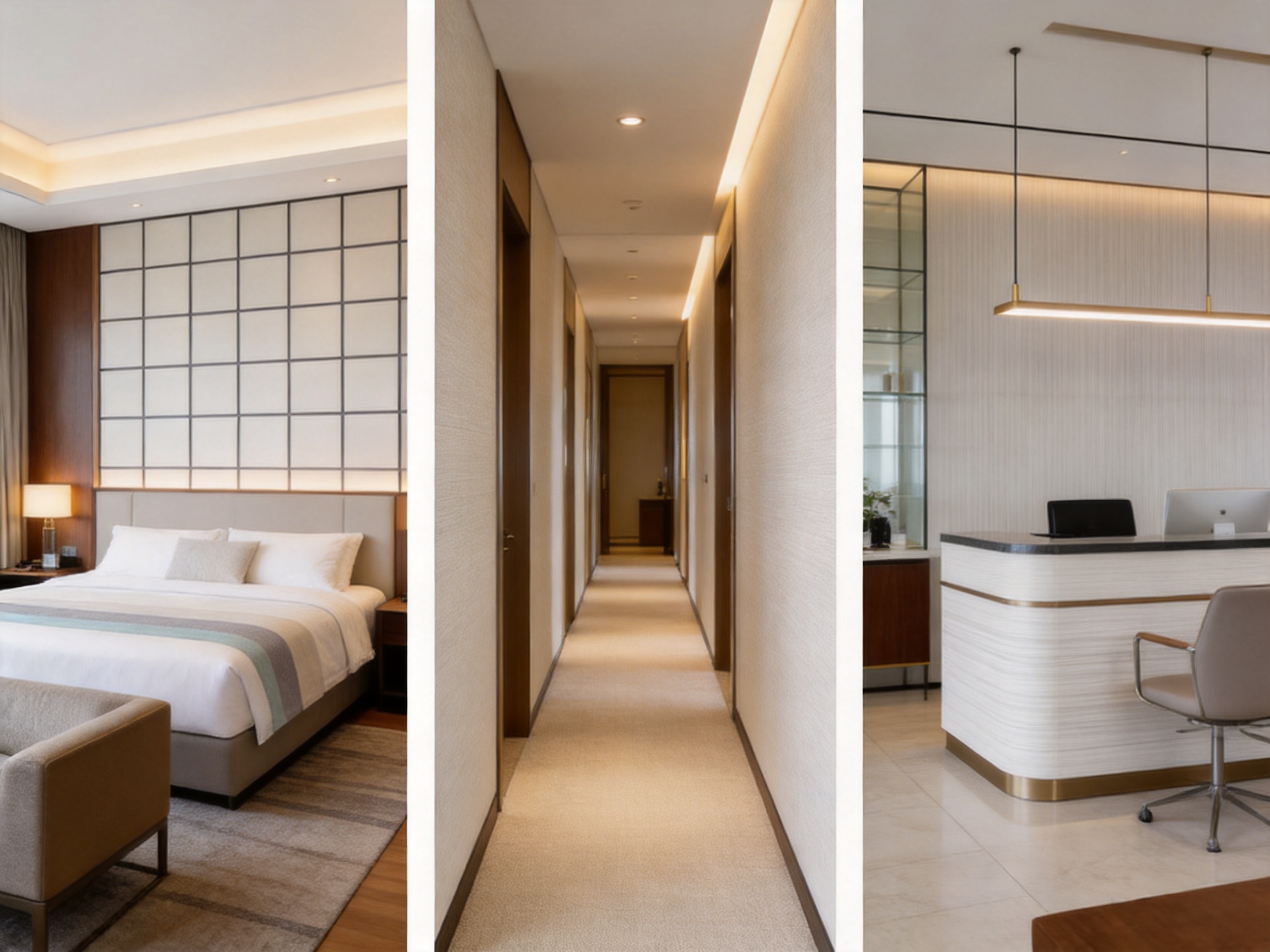
The product is positioned for a broad range of uses, including hotel decoration, whole-house wall applications, living rooms, bedrooms, corridors, office interiors, retail spaces, and other commercial environments. Because the surface is moisture-resistant, stain-resistant, and simple to clean, it can be considered for areas where decorative performance must be balanced with daily practicality.
| Item | Specification or Description | Value for Interior Projects |
|---|---|---|
| Product type | Square Pattern PVC Wallpaper | Decorative wall covering for residential and commercial interiors |
| Surface | PVC square pattern printing and embossing | Creates tactile texture, visual depth, and a contemporary finish |
| Pattern options | Square grid, linen-inspired, and striped patterns | Supports modern, understated, and coordinated design concepts |
| Color | Existing pattern colors or customized colors | Allows matching with furniture, flooring, lighting, and brand interiors |
| Thickness | 0.12OZ–0.5OZ as provided | Suitable thickness should be confirmed according to the intended application and measurement standard |
| Width | Regular size of 1370 mm or customized | Helps support efficient wall coverage and project planning |
| Application | Wrapping directly on a prepared wall surface | Enables a practical decorative installation process |
| Key properties | Waterproof, stain-resistant, anti-fingerprint, color-stable, fireproof, weather-resistant, and environmentally conscious | Provides durability and easier long-term maintenance |
Because thickness specifications can be expressed differently across suppliers and markets, project buyers should confirm whether the stated 0.12OZ–0.5OZ range refers to ounces, millimeters, or another internal specification. Final technical documentation, sample approval, and application testing should be completed before large-scale installation.
2. Contemporary Surface Design
The central visual characteristic of this wallpaper is its geometric surface language. Square patterns create an organized rhythm that can make a wall appear structured and architectural. The design can be used as a subtle background or as a stronger decorative element, depending on the selected color, scale, embossing depth, and lighting conditions.
Square grids are particularly suitable for contemporary interiors because they complement straight architectural lines, modular furniture, metal details, glass partitions, and simplified lighting systems. In a hotel room, for example, a softly colored square pattern can add texture behind a bed without competing with artwork or furniture. In a corridor, the same pattern can help establish a consistent visual identity across multiple areas.
Linen-inspired patterns provide a softer alternative. They can introduce a textile-like impression while offering the cleanability and water resistance associated with PVC. This makes them useful for hospitality spaces that need to feel comfortable and residential without relying entirely on fabric wall coverings.
Striped patterns provide additional flexibility. Vertical visual lines can support a sense of height, while horizontal or irregular stripes may help broaden the perceived proportions of a wall. Depending on the design direction, stripes can be used in bedrooms, reception areas, restaurants, offices, and retail interiors.
2.1 Tactile depth and visual balance
The surface combines printing with embossing. Printing supplies the visible pattern and color, while embossing creates physical relief that can be felt by touch and observed as light moves across the wall. This combination is more expressive than a completely flat printed film and can provide a more finished appearance than a simple painted surface.
Balanced embossing is important in interior decoration. If a surface is too flat, it may appear ordinary or lack character. If it is excessively deep, dust collection and installation challenges may increase. The product’s stated skin-touch surface is intended to provide a comfortable tactile quality while preserving a practical decorative finish.
Texture also affects how an interior is perceived. Softly embossed surfaces can reduce the visual harshness of large flat walls. They may help create a calm atmosphere in bedrooms and living rooms, while geometric relief can provide a more professional impression in offices, hotels, and commercial spaces.
3. Material Advantages of PVC Wallpaper
PVC is widely used in decorative surface applications because it can be formulated and processed to deliver a combination of flexibility, moisture resistance, surface durability, and design versatility. In wallpaper applications, the material can be printed, embossed, colored, and finished in ways that support a wide variety of interior concepts.
3.1 Moisture resistance
Moisture resistance is one of the most important distinctions between PVC wallpaper and many conventional paper-based wall coverings. In everyday use, walls may be exposed to humidity, cleaning activities, accidental splashes, or condensation. A moisture-resistant PVC surface is better prepared for these conditions than untreated paper.
This feature is especially valuable in hotels, rental properties, corridors, dining areas, and high-traffic interiors where maintenance teams need to clean surfaces regularly. Moisture resistance does not mean that every PVC wallpaper installation is suitable for direct water exposure or continuously wet environments. Proper substrate preparation, joint treatment, ventilation, and application guidance remain essential.
3.2 Easy cleaning and stain resistance
The product is described as stain-resistant and easy to clean. These characteristics can reduce the effort required to preserve a fresh appearance during the service life of an interior. Dust, light marks, and everyday surface contamination can often be addressed more easily on a suitable PVC finish than on absorbent wall materials.
Cleaning procedures should always be selected according to the approved technical data. Strong solvents, abrasive pads, excessive moisture, or aggressive chemicals may damage decorative printing or surface embossing. A soft cloth, mild cleaning solution, and controlled wiping method are generally more appropriate unless the manufacturer specifies otherwise.
3.3 Anti-fingerprint performance
The anti-fingerprint feature is particularly useful in areas where people frequently touch walls, doorside sections, corridors, elevator approaches, and hospitality spaces. Finger marks can reduce the perceived quality of a decorative surface, especially on darker colors or smooth finishes. A surface designed to resist visible fingerprints helps maintain a cleaner appearance between maintenance cycles.
3.4 Color stability
Color stability supports long-term design consistency. Interior surfaces may be exposed to artificial lighting, daylight, cleaning, and regular contact. A color-stable decorative film can help reduce premature fading or visual inconsistency. Actual performance depends on the selected color, exposure conditions, formulation, printing method, and installation environment, so sample testing remains advisable for projects with strong lighting or long service expectations.
3.5 Waterproof and fireproof characteristics
The supplied product information identifies the wallpaper as waterproof and fireproof. These properties can provide additional value in commercial and hospitality projects where material performance is an important part of project planning. However, fire performance should be verified through current test reports and applicable local standards before the product is specified for regulated buildings.
Fire classifications vary by country and may depend on the complete wall assembly, including the substrate, adhesive, backing, joints, and installation method. A product-level description should therefore be treated as an initial performance indication rather than a substitute for project-specific compliance documentation.
3.6 Weather resistance and environmental considerations
The product is also described as offering good weather resistance and an environmentally friendly profile. These characteristics may be relevant to semi-enclosed areas, high-light interiors, and projects seeking more durable decorative materials. Environmental claims should be reviewed together with available material declarations, production information, emissions data, recycling guidance, and local regulatory requirements.
Durability itself can contribute to more responsible material use because a surface that remains attractive and serviceable for longer may reduce the frequency of replacement. Responsible specification should also consider efficient cutting, installation waste, end-of-life handling, and the environmental profile of adhesives and supporting materials.

Square Pattern PVC Wallpaper
4. Advantages Compared with Conventional Wall Finishes
Interior designers and project owners typically compare wallpaper with paint, paper wallpaper, fabric coverings, laminate panels, wood-based boards, and other decorative films. Each option has a suitable field of use. Square Pattern PVC Wallpaper offers a particularly useful balance between decorative detail and practical maintenance.
4.1 Compared with ordinary paint
Paint provides broad color freedom and can be economical for large surfaces, but it generally produces a flat finish unless special coating techniques are used. It may also show scuffs, fingerprints, stains, and uneven substrate conditions. Repainting can be disruptive in operating hotels, offices, and residential buildings.
Square Pattern PVC Wallpaper adds a finished pattern and tactile effect in a single decorative layer. The embossed surface can conceal minor visual irregularities more effectively than a plain painted wall, although substantial cracks, dampness, or unevenness must still be corrected before installation. The wallpaper can also establish a stronger design identity than a single-color coating.
4.2 Compared with paper wallpaper
Paper wallpaper can offer attractive prints and a traditional decorative feel, but it may be more sensitive to moisture, tearing, staining, and difficult cleaning conditions. PVC wallpaper is generally more appropriate where the wall covering must tolerate regular maintenance and moderate humidity.
The PVC surface also supports embossing and tactile finishes that can imitate textile or structured materials. This allows designers to achieve a richer visual effect without using natural fabric, which may require more specialized care.
4.3 Compared with fabric wall coverings
Fabric coverings can provide warmth and acoustic softness, but they may absorb stains, retain dust, and require specialist cleaning. Square Pattern PVC Wallpaper offers a textile-inspired appearance with a more wipeable surface. It may therefore be advantageous in hotels, corridors, rental properties, and public interiors where maintenance efficiency is a priority.
Fabric and PVC wallpaper are not identical in performance. Where acoustic absorption is a primary requirement, a dedicated acoustic system may be more suitable. The advantage of PVC wallpaper lies in its combination of decorative texture, cleanability, moisture resistance, and installation practicality.
4.4 Compared with decorative panels
Rigid decorative panels can provide excellent impact resistance and a strong three-dimensional effect, but they may require more substantial framing, cutting, transportation, and installation labor. Wallpaper is typically thinner and easier to adapt to large wall areas or interior layouts with multiple transitions.
PVC wallpaper can also reduce the visual heaviness sometimes associated with thick wall panels. It preserves a cleaner wall plane while still adding pattern and texture. For renovation projects, this can be useful when minimizing changes to existing room proportions is important.
4.5 Compared with low-quality decorative films
Low-quality films may suffer from unstable color, poor adhesion, weak surface resistance, difficult handling, or visible pattern inconsistency. A professionally developed wallpaper product benefits from controlled raw materials, defined printing and embossing processes, quality inspection, and more consistent production management.
The product’s stated anti-fingerprint, stain-resistant, color-stable, waterproof, and tactile properties indicate that it is intended as a performance-oriented decorative surface rather than a temporary visual covering.
5. Applications in Residential Interiors
For residential projects, the product can support coordinated decoration throughout an entire house. A single pattern family can be used in multiple rooms while varying the color or orientation to create visual continuity without making every space identical.
5.1 Living rooms
Living rooms often require a wall finish that appears attractive under both daylight and artificial lighting. A square grid can provide a structured background for sofas, shelving, artwork, and television walls. A linen-inspired design can produce a calmer appearance, particularly when paired with wood, stone, neutral fabrics, and warm lighting.
Because the surface is designed to be easy to clean, it may be useful in family homes where walls are exposed to regular contact. The selected pattern should be coordinated with furniture scale. Large furniture may pair well with a restrained grid, while smaller furnishings can accommodate a more visible stripe or textured design.
5.2 Bedrooms
Bedrooms benefit from surfaces that create comfort without excessive visual stimulation. Soft colors, fine square patterns, and textile-inspired embossing can contribute to a relaxed atmosphere. The material can be used behind the headboard, on a feature wall, or across the full room depending on the design plan.
For bedrooms with strong sunlight, color selection and product testing are recommended. Light-colored surfaces may create a brighter appearance, while deeper tones can provide a more intimate mood. Lighting samples should be reviewed because embossing can produce different shadows at different times of day.
5.3 Corridors and entrance areas
Corridors and entryways are exposed to frequent movement and contact. Their walls can become marked more quickly than walls in private rooms. A stain-resistant, anti-fingerprint PVC surface can help maintain a clean and organized appearance.
Square patterns are especially suitable for corridors because they support a sense of rhythm along long wall sections. Stripes may emphasize direction and movement, while linen patterns can soften narrow spaces.
5.4 Kitchens and adjacent areas
The product’s moisture resistance and cleanability may make it suitable for selected kitchen-adjacent walls or dining areas, provided that the installation environment does not involve direct heat, continuous water exposure, or contact with grease beyond the product’s approved limits. Areas immediately behind cookers, sinks, or other high-risk zones should be evaluated separately.
6. Applications in Hotels and Commercial Spaces
Hotels require materials that support brand identity, guest comfort, maintenance efficiency, and consistent appearance across many rooms. Square Pattern PVC Wallpaper can help create a repeatable decorative language across guest rooms, corridors, reception areas, lounges, restaurants, and meeting spaces.
6.1 Guest rooms
In guest rooms, wall coverings must look refined while tolerating cleaning and frequent occupancy. The wallpaper’s tactile patterns can add a premium impression without relying on complicated wall construction. A neutral square design can complement multiple furniture styles and reduce the risk that the interior will appear outdated quickly.
6.2 Hotel corridors
Corridors are among the most demanding hotel areas because they receive continuous traffic, luggage contact, service activity, and repeated cleaning. A moisture-resistant and stain-resistant surface may help lower the visual impact of routine marks. The use of a consistent pattern can also make long corridors feel more intentional and visually coordinated.
6.3 Reception areas and public spaces
Reception areas create the first impression of a hotel, office, restaurant, or commercial facility. Geometric PVC wallpaper can support a modern identity while remaining more practical than fragile decorative materials. It can be combined with indirect lighting, metal trims, wood elements, stone surfaces, and signage.
6.4 Offices and retail interiors
Offices often need wall finishes that appear professional without becoming distracting. Fine square patterns and understated linen textures can provide a background for meeting rooms, workspaces, and reception zones. Retail interiors can use stronger color contrasts or striped designs to create zones, guide movement, or reinforce a visual merchandising concept.
7. Manufacturing and Product Development Strengths
The performance of a decorative film or wallpaper depends not only on its visible design but also on the consistency of its manufacturing process. Raw material selection, formulation, printing, embossing, surface finishing, quality inspection, packaging, and technical support all influence the final result.
ZheJiang ZhongSheng New Materials Co., Ltd. was established in 2006 and has developed extensive experience in plastic sheet and film manufacturing. The company operates a manufacturing area of approximately 40,000 square meters and has a registered capital of approximately 11.21 million U.S. dollars. Its production infrastructure includes one research and development team, two laboratories, 33 production lines, and more than 100 sets of machinery and equipment.
The company’s stated annual production capacity is approximately 70,000 tons. Its product portfolio includes PETA, PETG, and PET-GAG materials used in thermoforming, vacuum forming, blister packaging, furniture decorative film panels, and related applications. This background gives the organization experience in polymer processing, film production, surface appearance, dimensional control, and industrial-scale manufacturing.
7.1 Polymer processing experience
Plastic sheet and film production requires careful management of temperature, pressure, material flow, cooling, winding, and dimensional stability. These capabilities are relevant to decorative wallpaper because a wall covering must remain consistent in thickness, appearance, flexibility, and handling performance.
Experience with transparent and decorative plastic products can also support the development of controlled surface finishes. Printing and embossing must be aligned so that the visual pattern and tactile relief remain consistent across the roll. Process stability is especially important when a pattern includes fine grids, repeated stripes, or subtle textile effects.
7.2 Research and development capability
The company reports having an R&D team and two laboratories. These resources can support formulation development, material evaluation, process optimization, pattern testing, and performance verification. For decorative products, research and development may involve more than creating attractive colors. It can also include improving surface feel, stain resistance, print clarity, embossing definition, flexibility, and long-term appearance.
A structured development process helps transform a design concept into a repeatable industrial product. Sample panels and trial rolls can be evaluated under different lighting conditions and installation methods before a design is released for broader production.
7.3 Production scale and supply capability
A production network with 33 lines and more than 100 sets of equipment provides the potential to support both standard products and project-based orders. Scale can be valuable for hotel groups, contractors, distributors, and interior brands that require repeat supply across multiple locations.
Large-scale manufacturing may also improve planning for raw materials, production scheduling, inspection, packaging, and shipment. Buyers should still confirm the specific line, lead time, minimum order quantity, batch consistency, and quality documentation for each wallpaper project.
7.4 Quality-oriented management
The company emphasizes development through quality and brand building through integrity. For a decorative wall covering, quality management should address color consistency, surface defects, print alignment, embossing uniformity, roll winding, edge condition, packaging protection, and labeling.
Quality inspection is particularly important for geometric patterns. Even a small deviation in repeat spacing or printing alignment can become noticeable when multiple rolls are installed side by side. A controlled inspection process helps reduce the risk of visible pattern mismatch and supports smoother installation.
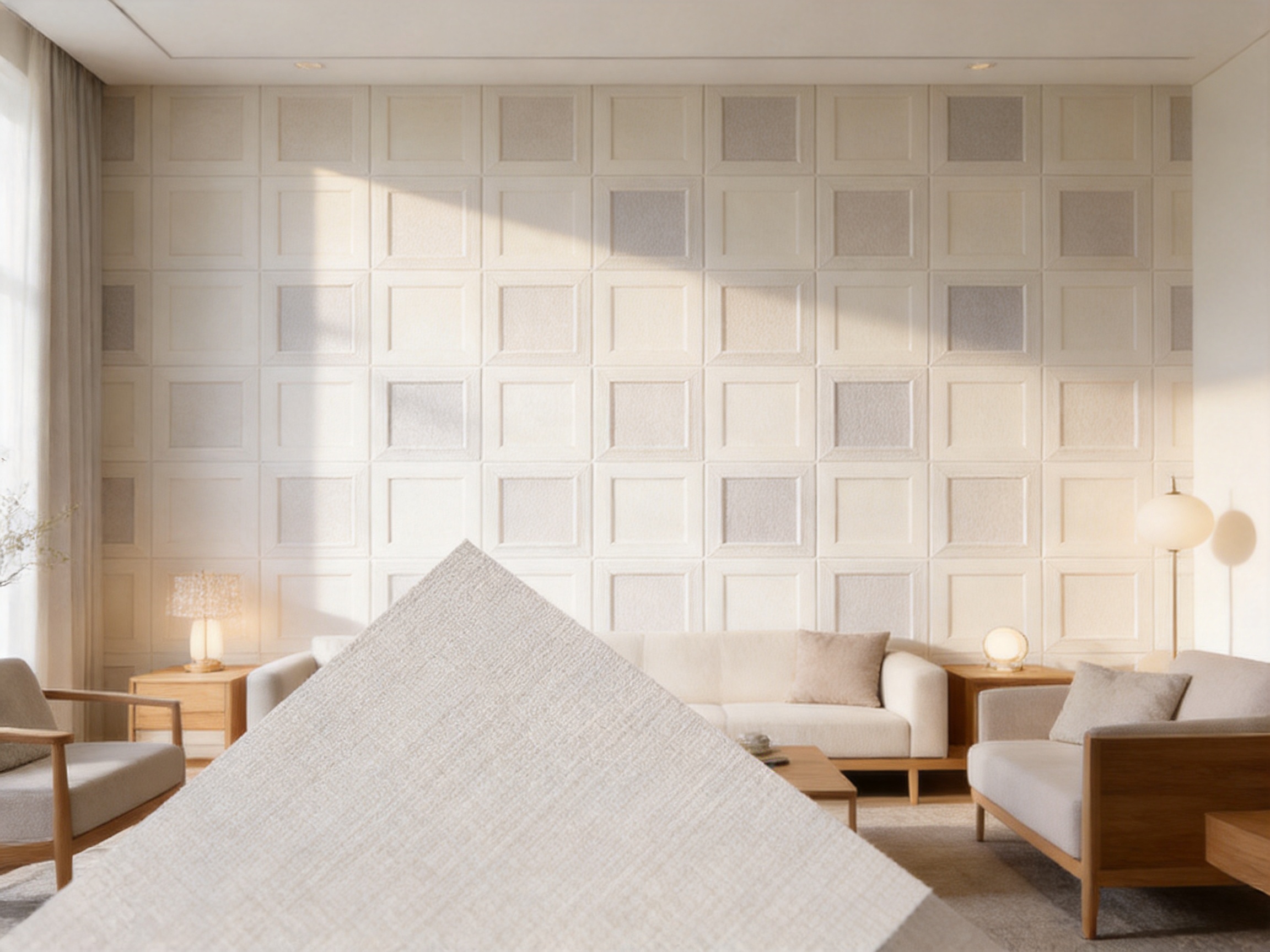
8. Recommended Manufacturing Process for the Wallpaper
The exact production formula and line configuration may vary according to the selected pattern, color, thickness, and final application. However, a typical PVC decorative wallpaper process involves several coordinated stages.
8.1 Material preparation
PVC resin and approved additives are prepared according to the required formulation. Depending on the product structure, the formulation may be designed to support flexibility, surface durability, print receptivity, color stability, and processing performance. Additive selection should be controlled carefully because it can affect odor, migration, surface feel, and long-term behavior.
8.2 Film or sheet forming
The prepared material is processed into a controlled sheet or film. During this stage, temperature and material flow influence thickness, smoothness, flexibility, and dimensional stability. Consistent sheet formation provides a reliable base for later printing and embossing operations.
8.3 Surface printing
The square, linen, or striped design is printed onto the PVC surface using a controlled decorative printing process. Color matching, repeat length, registration, ink adhesion, and print clarity must be monitored. The ability to reproduce the same design across multiple production batches is important for large interior projects.
8.4 Embossing
Embossing creates the tactile relief that gives the wallpaper its skin-touch quality and visual depth. The embossing pattern must align appropriately with the printed design. Pressure, temperature, roller condition, and line speed can influence the sharpness and consistency of the relief.
8.5 Surface finishing
Additional surface treatment may be used to support stain resistance, anti-fingerprint behavior, cleanability, and appearance retention. Any finish should be compatible with the underlying print and embossing. It should also remain stable during roll storage, transportation, installation, and routine cleaning.
8.6 Inspection and roll conversion
After processing, the product can be inspected for color, pattern alignment, surface defects, width, thickness, edge condition, and winding quality. Rolls are then converted, labeled, and packaged according to project requirements. Protective packaging is important because pressure, moisture, and rough handling can affect the appearance of the surface before installation.
9. Installation Considerations
Good installation begins with substrate preparation. The wall should be clean, dry, stable, smooth, and free from dust, oil, loose paint, dampness, and structural movement. Cracks, holes, uneven areas, and absorbency differences should be addressed before wallpaper application.
Moisture is one of the most important risks. Even a moisture-resistant surface can perform poorly if it is installed over a damp wall. Excess moisture may cause adhesion failure, bubbling, mildew, discoloration, or substrate deterioration. Moisture testing and appropriate priming are recommended for renovation and newly constructed spaces.
9.1 Acclimatization and inspection
Before installation, rolls should be stored in a clean, dry environment and allowed to reach the recommended room conditions. Installers should inspect the material for visible defects, verify the pattern, and compare batch information. If multiple rolls are used on the same wall, they should be checked for color and pattern continuity before cutting.
9.2 Adhesive compatibility
The adhesive should be compatible with PVC wallpaper and the wall substrate. Application quantity, open time, drying conditions, and working temperature can influence final adhesion. Using the wrong adhesive may lead to lifting, seam opening, staining, or uneven drying.
9.3 Pattern matching
Square grids and stripes require careful alignment. Installers should establish a reference line and plan the sequence before applying the first sheet. Pattern matching is especially important at corners, around doors and windows, and where separate wall sections meet.
9.4 Seam treatment
Seams should be pressed carefully without damaging the embossed surface. Excess adhesive should be removed promptly using the recommended method. Strong rubbing or scraping can alter the surface appearance, particularly on textured or printed areas.
9.5 Post-installation care
The room should be ventilated appropriately after installation while avoiding rapid drying caused by excessive heat or strong drafts. Newly installed wallpaper should not be exposed to intensive cleaning until the adhesive has fully cured. The maintenance team should receive instructions regarding suitable cleaning agents and methods.
10. Design Coordination and Specification Guidance
Designers can maximize the product’s value by considering the relationship between pattern scale, wall size, lighting, furniture, and room function. A small square repeat may appear refined and subtle across a large wall, while a larger repeat can create a stronger architectural statement.
10.1 Color selection
Neutral colors such as warm white, beige, gray, and soft taupe can support broad design flexibility. Darker colors may create a more dramatic impression but should be evaluated under the actual lighting plan because embossing can produce stronger shadows. Custom color development can help match a hotel identity, residential palette, or commercial brand environment.
10.2 Combining patterns
Square, linen, and striped designs can be coordinated within one project if their color families and visual weights are carefully controlled. A square pattern may be used in a main public area, a linen texture in guest rooms, and a stripe in corridors. Keeping a consistent tonal range can maintain unity while allowing each zone to have its own character.
10.3 Lighting interaction
Embossed surfaces respond strongly to directional lighting. Wall washers can emphasize texture, while diffused lighting can create a softer appearance. Sample boards should be reviewed under the planned lighting conditions rather than only under showroom lighting.
10.4 Material combinations
The wallpaper can be paired with wood, stone, glass, metal, fabric, and painted surfaces. Linen-inspired patterns work well with natural materials, while geometric squares can complement metal and glass in modern commercial interiors. Designers should avoid combining too many competing textures in a small room.
11. Sustainability and Long-Term Value
Environmental performance should be assessed across the entire product life cycle. Relevant factors include material composition, production efficiency, durability, cleaning requirements, packaging, installation waste, indoor emissions, and end-of-life treatment.
A durable wall covering may reduce the need for frequent replacement, especially in high-use spaces. Its moisture resistance and cleanability can also help maintain appearance without repeated repainting or replacement. However, responsible selection requires project-specific evidence, including available environmental declarations, compliance documents, and indoor air quality information.
Manufacturers and buyers can further improve resource efficiency by optimizing roll dimensions, reducing cutting waste, selecting recyclable packaging where practical, and planning installation carefully. The regular 1370-millimeter width may support efficient coverage, but layout optimization should be performed for each wall plan.
Environmental claims should be communicated accurately. Terms such as environmentally friendly should be supported by relevant technical information and should not replace proper evaluation of the complete installation system.
12. Why Choose a Specialized Manufacturer
Choosing a specialized manufacturer can provide advantages beyond the product itself. A manufacturer with long-term experience in plastic sheets and films is more likely to understand the relationship between polymer formulation, processing conditions, surface appearance, and dimensional stability.
For buyers, manufacturing depth can support more reliable communication from sampling through mass production. It may also make it easier to discuss custom colors, pattern development, width requirements, packaging, and repeat orders. Technical cooperation is particularly important for hotels, contractors, and distributors that need consistent supply across multiple projects.
ZheJiang ZhongSheng New Materials Co., Ltd. has more than 16 years of stated focus on the PET industry and reports more than 60 invention and utility patents. Its self-developed PETG films are used in furniture decoration panels and other applications, demonstrating experience with decorative plastic surfaces and downstream manufacturing requirements.
Although the company’s wider portfolio includes PET-based products, buyers should request product-specific information for Square Pattern PVC Wallpaper, including formulation details where available, technical data sheets, applicable fire test reports, environmental documentation, sample approval procedures, production tolerances, and installation recommendations.
13. Quality Control Checklist for Buyers
Before approving a large order, buyers should evaluate representative samples and confirm the following points:
- Color consistency between sample, approved master, and production batch.
- Pattern repeat accuracy and registration between printing and embossing.
- Surface feel, embossing uniformity, and resistance to ordinary handling.
- Width, thickness, roll length, edge condition, and winding quality.
- Stain resistance and cleaning performance under the intended maintenance method.
- Moisture resistance for the planned interior environment.
- Fire performance according to the applicable local building standard.
- Adhesive compatibility and installation instructions.
- Packaging protection during storage and transportation.
- Availability of replacement rolls or repeat production for future repairs.
For large projects, a mock-up wall is recommended. The mock-up should use the proposed substrate, adhesive, lighting, joint arrangement, and cleaning method. This allows the design team, contractor, and manufacturer to identify potential issues before the main installation begins.
14. Commercial and Project Benefits
From a project management perspective, the product offers several practical benefits. Its 1370-millimeter standard width can support efficient planning for many wall layouts, while customized dimensions may help address specific project needs. The product can also provide a consistent decorative finish across multiple rooms without requiring complex construction.
For hotels and commercial interiors, visual consistency is often essential. A controlled wallpaper design can be repeated across rooms and floors, helping establish a recognizable atmosphere. If future repair is required, retaining batch records and spare rolls can reduce the risk of visible color differences.
Maintenance teams may benefit from the wipeable, stain-resistant surface. Reducing the time required to clean minor marks can contribute to more efficient facility management. The actual maintenance benefit will depend on the degree of traffic, the type of contamination, and the cleaning protocol.
For residential developers, the product can support differentiated interior packages. Standard patterns can be used for cost-controlled units, while custom colors or selected textures can be offered for premium spaces. This flexibility allows a single product family to serve several market segments.
15. Limitations and Responsible Specification
No decorative wall covering is suitable for every environment. PVC wallpaper should not be specified without considering direct heat, continuous water exposure, severe impact, substrate movement, or local fire regulations. The product should be matched to the performance requirements of each room.
Wall preparation is equally important. A high-quality wallpaper cannot compensate for dampness, unstable plaster, contaminated surfaces, or major structural cracks. Installation workmanship can affect the final result as much as the material itself.
Buyers should also confirm all units and test methods in the technical documents. The supplied thickness range is written as 0.12OZ–0.5OZ, which should be clarified before comparison with products using millimeter or micrometer specifications. Clear documentation prevents misunderstandings during purchasing, inspection, and installation.
For regulated projects, claims such as fireproof, waterproof, and environmentally friendly should be supported by current, product-specific evidence. Test reports should identify the tested construction and conditions so that project teams can determine whether the results apply to the planned installation.
16. Frequently Asked Questions
Q1. What is Square Pattern PVC Wallpaper?
Square Pattern PVC Wallpaper is a decorative PVC wall covering featuring square grid designs, linen-inspired textures, and striped patterns. It combines printed decoration with embossing to create a tactile, modern wall surface.
Q2. Where can this wallpaper be used?
It is intended for hotel decoration, whole-house wall applications, living rooms, bedrooms, corridors, offices, retail interiors, and other commercial or residential spaces. The suitability of each location should be confirmed according to moisture, heat, traffic, fire, and cleaning requirements.
Q3. Is the wallpaper suitable for humid environments?
The product is described as moisture-resistant and waterproof, which can make it suitable for many normal interior environments with moderate humidity. It should not automatically be used in continuously wet areas, direct shower zones, or locations exposed to intense heat and water without specific technical approval.
Q4. Can the color be customized?
Yes. The supplied information states that colors can follow existing patterns or be customized. Custom color approval should be based on physical samples reviewed under the project’s actual lighting conditions.
Q5. What is the standard width?
The regular width is 1370 millimeters, and customized widths may be available. Final width, tolerance, roll length, and production conditions should be confirmed before ordering.
Q6. How should the stated thickness be interpreted?
The supplied specification lists thickness as 0.12OZ–0.5OZ. Because this unit is not a conventional thickness format in many wallpaper specifications, buyers should confirm the intended unit and measurement method with the supplier before comparing it with other products.
Q7. Does the surface resist fingerprints and stains?
The product is specified as anti-fingerprint and stain-resistant. These properties can help preserve a cleaner appearance, but cleaning products and procedures should follow the manufacturer’s recommendations.
Q8. Is the wallpaper fireproof?
The product information identifies it as fireproof. For a construction project, the buyer should request current fire-performance test documentation and verify compliance with the applicable local building code. Fire performance can depend on the complete wall assembly and installation method.
Q9. Can it be installed directly on any wall?
It is designed for application to a prepared wall surface. The wall must be dry, smooth, clean, stable, and free from loose material, grease, and significant defects. Damp or uneven substrates should be corrected before installation.
Q10. What makes it different from ordinary paper wallpaper?
PVC wallpaper generally offers stronger resistance to moisture, staining, and routine cleaning than many untreated paper wallpapers. It also supports embossing and tactile finishes. The best choice depends on the project’s design, maintenance, environmental, and regulatory requirements.
Q11. Can the wallpaper be used in hotels?
Yes. Its patterns, cleanability, moisture resistance, and potential for repeat production make it suitable for many hotel applications, including guest rooms, corridors, reception areas, and public spaces. A project mock-up and technical review are recommended before full installation.
Q12. What manufacturing strengths support this product?
The manufacturer reports a 40,000-square-meter manufacturing area, 33 production lines, more than 100 sets of machinery and equipment, two laboratories, an R&D team, and annual production capacity of approximately 70,000 tons. The company also has experience in plastic sheets, films, thermoforming materials, and decorative film panels.
Q13. Can the product support large projects?
The company’s production scale and broad manufacturing infrastructure may support large residential, hospitality, and commercial projects. Buyers should confirm capacity, lead time, minimum order quantity, batch control, packaging, and repeat-order arrangements for the specific design.
Q14. How should the product be cleaned?
Routine cleaning should use a soft cloth and a mild, compatible cleaning solution unless the manufacturer provides different instructions. Abrasive pads, strong solvents, and excessive water should be avoided unless specifically approved.
Q15. What should be checked before placing an order?
Buyers should confirm the approved color, pattern repeat, width, thickness unit, roll length, surface performance, fire documentation, environmental information, adhesive compatibility, installation instructions, packaging, and quality inspection procedure.
17. Conclusion
Square Pattern PVC Wallpaper offers a practical way to introduce geometric structure, textile-inspired texture, and refined surface depth into modern interiors. Its PVC construction, embossed finish, moisture resistance, cleanability, anti-fingerprint performance, and color options make it a versatile alternative to ordinary paint, paper wallpaper, and some more maintenance-intensive decorative coverings.
The product is suitable for residential and commercial applications ranging from living rooms and bedrooms to hotel corridors, offices, retail interiors, and whole-house decoration. Its square, linen, and striped patterns can be coordinated with different design styles, while the 1370-millimeter standard width and customization potential support a variety of project requirements.
Its value is strengthened by the manufacturer’s broader experience in plastic sheet and film production. With a substantial manufacturing area, multiple laboratories, an R&D team, extensive production equipment, numerous production lines, large annual capacity, and a history of polymer product development, ZheJiang ZhongSheng New Materials Co., Ltd. has the infrastructure to support consistent industrial production and project-based cooperation.
For the best result, material selection should be combined with substrate testing, sample approval, correct adhesive selection, professional installation, and product-specific documentation. When these factors are properly managed, Square Pattern PVC Wallpaper can deliver a durable, attractive, and maintainable surface for contemporary interior environments.
References
1. Product specification information for Square Pattern PVC Wallpaper, including surface, color, width, thickness, application, and performance characteristics.
2. Company profile and manufacturing information supplied by ZheJiang ZhongSheng New Materials Co., Ltd.
3. General principles of polymer sheet and film processing, including forming, printing, embossing, surface finishing, and quality inspection.
4. General interior wall-covering installation practices covering substrate preparation, adhesive compatibility, seam treatment, cleaning, and post-installation care.
5. General building-material specification principles concerning moisture resistance, fire-performance verification, environmental documentation, and project-specific testing.
6. General design considerations for geometric patterns, embossed surfaces, lighting interaction, residential interiors, hospitality spaces, and commercial environments.